title: "The Fused State Representation"
description: Discover how 33MED's ImmuNav engine utilizes a lean, autonomous Node.js architecture to generate high-fidelity 3D biomechanical models of Ankylosing Spondylitis damage for surgical robotics.
date: 2024-05-24
author: "33MED Engineering"
category: "Spine3D, Biomechanics & Surgical Robotics"
The Fused State Representation: Accurately Visualizing Ankylosing Spondylitis Damage in 3D
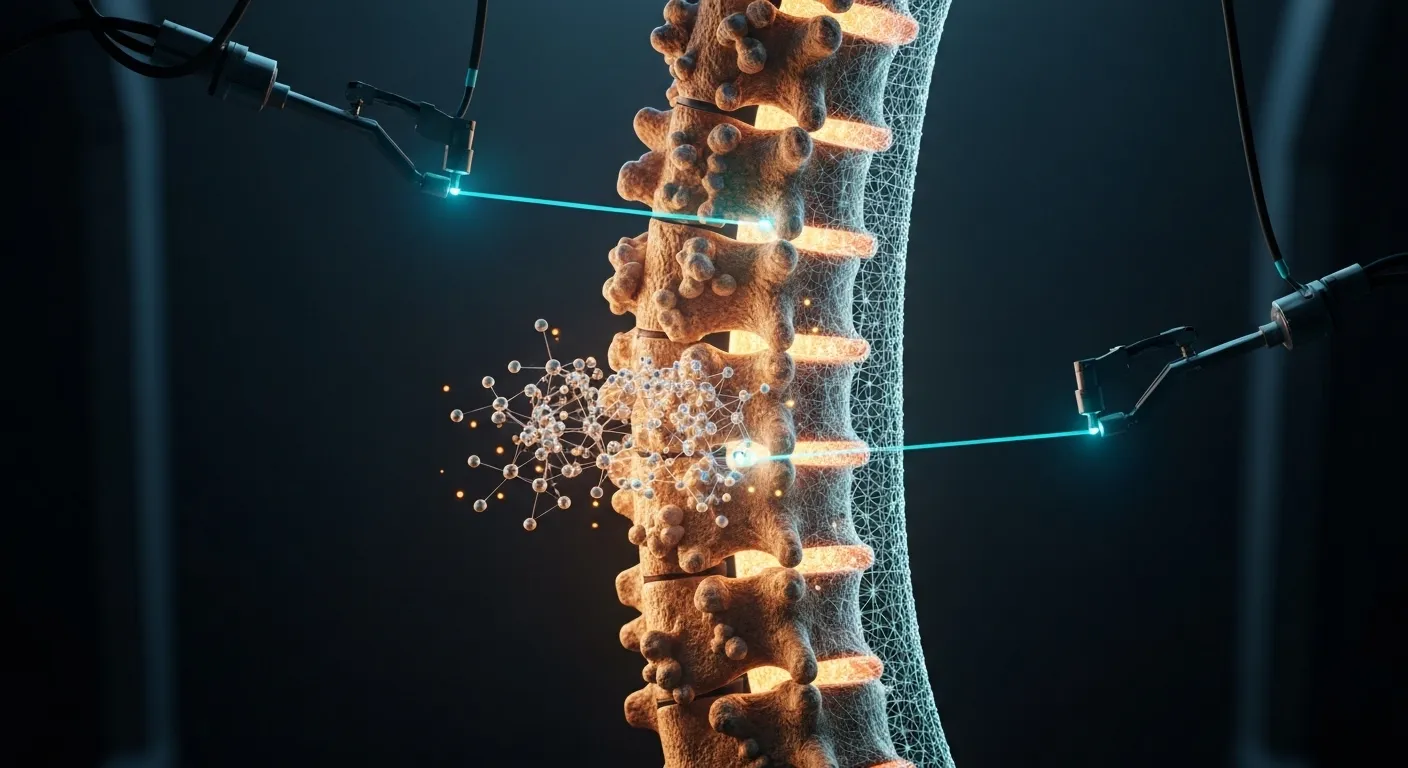
Ankylosing Spondylitis (AS) presents one of the most formidable challenges in orthopedic surgery and computational immunology. The pathological progression—driven by systemic inflammation and the unchecked growth of syndesmophytes—ultimately transforms a dynamic, articulated spinal column into a rigid, fused biomechanical structure. We call this endpoint The Fused State.
For surgical robotics to successfully navigate, resect, or stabilize a fused spine, standard 2D imaging is insufficient. We require a highly accurate, multi-scale 3D representation that maps not just the macro-level bone topography, but the underlying cellular calcification and molecular thermodynamics driving the disease.
At 33MED, we are bridging this gap with ImmuNav, our foundational Phase 1 engine. To achieve commercial-grade performance without the academic infrastructure bloat of complex Python frameworks or message brokers like RabbitMQ, we have re-architected ImmuNav into a hyper-lean Node.js, MongoDB, and React ecosystem.
Here is an inside look at the autonomous biotech infrastructure powering our 3D visualization of the Fused State.
🏗️ The Native Node/Mongo Swarm Engine
To model the sheer complexity of AS spinal fusion, we require continuous data synthesis. Rather than relying on fragile, memory-heavy microservices, our architecture uses MongoDB as a durable, atomic task queue managed by a native Node.js background processing loop.
Our database architecture tracks agent parameters and manages the task pipeline via two foundational collections:
- The Agents Collection: Tracks the status and directives of our AI swarm (e.g.,
DataIngestion,BioinformaticsOperator), carrying explicit global objectives like "Identify molecular targets to halt syndesmophyte growth and spine fusion." - The Tasks Collection: A lightweight queue that handles strict payload validation (via Zod). It manages the orchestration of standalone computational tools, logging outputs, and managing mandatory human sign-offs before execution.
In our Simulation Worker, a recursive polling loop queries MongoDB for actionable jobs. It respects global pause states and checks for explicit human approvals before spawning native CLI binaries via Node's child_process.spawn(). This ensures deterministic execution and real-time stderr/stdout logging directly back to the database.
🧬 The Core Tool Matrix: Multi-Scale 3D Modeling
Building the Fused State representation requires a multi-scale approach—from atomic binding affinities to tissue-level mechanical stress. To maintain a safe, commercial-ready SaaS platform without licensing pitfalls, our Node.js backend bypasses restricted tools and orchestrates 100% free and commercial-safe open-source alternatives.
We build the 3D model through five critical computational pillars:
- Chai-1 / Boltz-1 (Apache 2.0 / MIT): Used for multimodal molecular and structure prediction of AS-specific targets (like IL-17 receptors). We execute these via standalone pre-compiled CLI binaries, dynamically passing JSON/SMILES inputs generated by our AI agents.
- GROMACS (GNU LGPL): Handles molecular dynamics and binding thermodynamics. By spawning native
gmxcommands, we monitor real-time thread progress as we simulate the efficacy of small-molecule inhibitors designed to halt syndesmophyte progression. - Bioconductor (Open Source): Executes standalone R scripts via
Rscriptto parse massive RNA/transcriptomic datasets, mapping the genetic expression pathways of spinal inflammation. - Chaste (BSD License): The engine behind our tissue-scale modeling. By firing compiled C++ binaries with XML payloads mapped by our agents, Chaste simulates the cellular calcification and bone-bridging characteristic of AS.
- OpenSim CLI (Apache 2.0): The final piece of the Fused State puzzle. We programmatically execute
opensim-cmdto validate the physical mechanical stresses and musculoskeletal load simulations on the newly fused 3D spinal joints, directly informing our surgical robotics trajectory planning (Spine3D).
📡 Automated Ingestion: Feeding the Biomechanical Matrix
A 3D model is only as accurate as the data that informs it. Our Data Ingestion Agents run as automated background tasks within Node.js, harvesting raw papers and utilizing AI to extract structured biological insights.
- PubMed Sourcing: Utilizing the NCBI Entrez E-utilities API, we run targeted queries (e.g.,
Ankylosing Spondylitis AND syndesmophyte) to pull literature at 10 requests/second. - arXiv Sourcing: We query the native arXiv Atom/XML feed endpoint to capture cutting-edge pre-prints in the
q-biocategory.
When the raw XML lands in our backend, it is passed directly to the Google Gemini SDK. Guided by strict systemic prompts acting as a computational immunologist, Gemini extracts explicit molecular targets, binding affinities, and genetic expressions, returning deterministic JSON payloads that instantly update our structural knowledge base.
🎛️ The Swarm Management Dashboard (HITL)
Autonomous infrastructure must be paired with absolute executive control. We do not allow black-box execution, especially when configuring simulations that will eventually guide surgical robotics.
Our React Frontend acts as a Human-In-The-Loop (HITL) Control Center. This dashboard provides:
- The Global Interrupter State: A single toggle that updates the MongoDB swarm status to
{ isPaused: true }. The background worker checks this boolean before processing any queued document, safely halting the swarm without breaking tasks mid-calculation. - The Guidance Injector: A text interface to input high-level directional pivots (e.g., "Focus explicitly on small-molecule inhibitors targeting IL-17 pathways"). This string is merged directly into the agent's system instructions for future payload generation.
- The Mandatory Approval Gate: Before a GROMACS molecular dynamics run or an OpenSim mechanical load calculation touches the hardware, the task enters a
pending_reviewstate. Engineers can view, verify, and manually tweak the Zod-validated JSON parameters (likenstepsordt) directly in the UI. Clicking Approve passes the job down to the local hardware execution loop.
🧪 Micro-Dataset Testing: Local Safety Loops
To iterate rapidly on our 3D visualization stack without exhausting API quotas or crashing machines under heavy computational physics, 33MED enforces a strict micro-testing protocol.
Before unleashing automated scripts on complex human spinal proteins, we sandbox our environment:
- Data Sourcing Limits: We hardcode low boundaries (
&retmax=3) into retrieval loops to verify regex sanitizers and Gemini extraction on tiny datasets. - Molecular Sandboxing (PDB: 1AKI): We benchmark Chai-1 and GROMACS scripts using Hen Egg White Lysozyme (1AKI), a standard, tiny structural model. Running an energy minimization sequence on 1AKI takes under two minutes, validating our Node runtime processes, exit codes, and stdout parsing.
- Mechanical Sandboxing: Before loading high-fidelity 3D AS skeletal rigs into Spine3D, we utilize the single-joint pendulum templates in OpenSim and 2D cellular grids in Chaste to ensure our React dashboard accurately renders configuration panels and post-run thermodynamic charts.
The Future of Spine3D
By stripping away software bloat and uniting Node.js orchestration with high-fidelity physics engines like Chaste and OpenSim, 33MED is not just visualizing Ankylosing Spondylitis. We are reverse-engineering The Fused State from the molecular level up to the biomechanical macro-structure, paving the way for the next generation of intelligent, autonomous surgical robotics.```