title: "The Chemical Roots of Mechanical Fusion"
description: "To cure Ankylosing Spondylitis, mitigating inflammation is insufficient. We must computationally map and halt aberrant osteogenesis using autonomous, commercial-grade biotech infrastructure."
date: 2023-10-25
author: "33MED Engineering"
category: "The \"Patient Zero\" AS Cure Methodology"
The Chemical Roots of Mechanical Fusion: Why Stopping Inflammation Isn't Enough
For decades, the standard of care in Ankylosing Spondylitis (AS) has been defined by a singular, reactive goal: suppress the immune system. Biologics targeting TNF-α and IL-17 pathways have revolutionized pain management and mobility, effectively dousing the systemic fire of inflammation. But clinical observation has revealed a sobering reality—dousing the fire does not stop the structural damage.
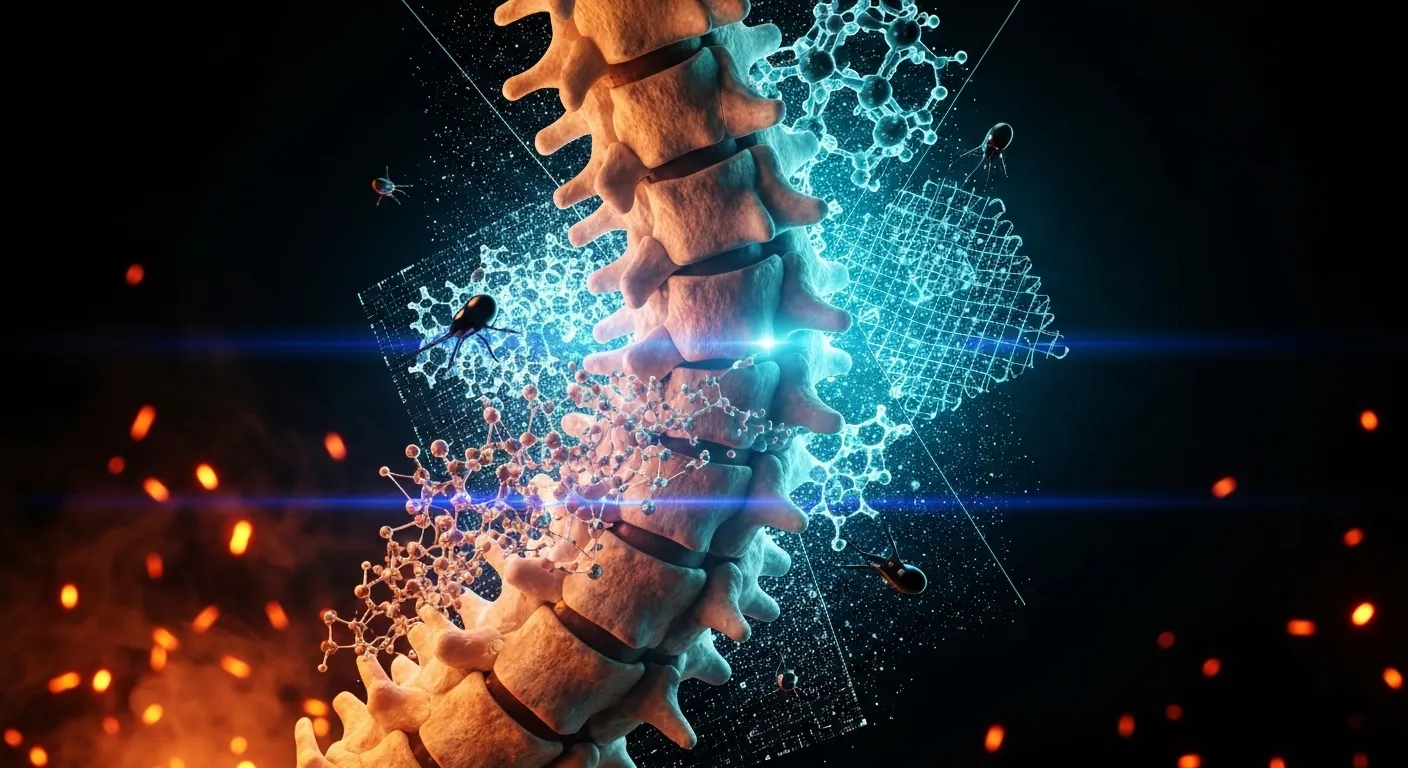
Even with controlled inflammatory markers, AS patients continue to develop syndesmophytes. The spinal vertebrae bridge, calcify, and fuse.
To achieve a true cure, we must pivot our computational focus. Stopping inflammation isn't enough; we must map and halt the downstream osteogenesis. At 33MED, our "Patient Zero" AS Cure Methodology leverages autonomous biotech infrastructure, computational immunology, and surgical robotics to isolate the precise chemical roots of this mechanical fusion.
To execute this, we have engineered ImmuNav—a highly performant, lean Phase 1 engine that strips out academic infrastructure bloat in favor of a devastatingly efficient Node.js, MongoDB, and React ecosystem.
Here is the technical blueprint of how ImmuNav is mapping the cure.
🧬 The Core Tool Matrix: 100% Commercial-Safe Orchestration
Academic bioinformatics is notoriously plagued by restrictive licensing (e.g., non-commercial wrappers around AlphaFold) and infrastructural bloat. To build a scalable B2B SaaS platform without licensing pitfalls, ImmuNav bypasses restricted tools, orchestrating fully open-source alternatives via native Node.js child_process CLI execution.
We map the journey from molecular binding to macroscopic bone fusion using the following commercial-safe matrix:
- Chai-1 & Boltz-1 (Free / Apache 2.0): Executed via standalone pre-compiled binaries to handle multimodal molecular and structural predictions. We pass dynamically generated JSON/SMILES inputs natively through Node.
- GROMACS (Free / GNU LGPL): Molecular dynamics and binding thermodynamics. ImmuNav spawns native
gmxcommands viachild_process.spawn()to monitor real-time thread progress as we evaluate small-molecule inhibitor affinities. - Bioconductor (Free / Open Source): Genomic and transcriptomic pathway mapping. Standalone R scripts parse RNA expression datasets to isolate the genetic triggers of osteogenesis.
- Chaste (Free / BSD): Tissue-scale cellular calcification modeling. We fire compiled C++ binaries with agent-generated XML payloads to map syndesmophyte cellular parameters.
- OpenSim CLI (Free / Apache 2.0): Musculoskeletal joint and muscle load simulation. Programmatic execution of
opensim-cmdvalidates the physical mechanical stresses of the fused spine.
🏗️ The Native Node/Mongo Swarm Engine
We have eliminated the need for complex, failure-prone message brokers like RabbitMQ or Kafka. Instead, ImmuNav relies on MongoDB acting as a durable, atomic task queue, managed by a lightweight Node.js background processing loop.
Schema Design for Autonomy
Our database architecture tracks agent parameters and manages the task pipeline using two foundational collections:
agentsCollection: Defines the role, status, and global objectives of the AI workers (e.g., “Focus explicitly on small-molecule inhibitors targeting IL-17 pathways that inhibit osteoblast differentiation.”).tasksCollection (The Queue): Stores payload data, tracks execution status (pending_review,queued,processing), and captures real-timestdout/stderrlogs directly from the spawned CLI binaries.
The Background Processing Loop
In the ImmuNav Simulation Worker, a recursive polling loop queries MongoDB for actionable jobs. It respects global pause states and demands human approvals before touching the compute hardware:
// Native binary execution via Node Child Processes
const binaryProcess = child_process.spawn(getToolBinary(task.tool), task.payload.cliArgs);

binaryProcess.stderr.on('data', (data) => {
  // Real-time runtime log streaming to MongoDB
  db.collection('tasks').updateOne({ _id: task._id }, { $push: { logs: data.toString() } });
});
This architecture ensures deterministic execution. If a GROMACS simulation fails, the error is atomically logged, and the loop instantly fetches the next queued job.
📡 The Data Collection Engine: Harvesting the Literature
To halt osteogenesis, we must ingest and synthesize decades of complex biomechanical and immunological research. Our Data Ingestion Agents run as automated background tasks, harvesting raw scientific literature and parsing it into structured, actionable biological insights.
- PubMed Sourcing: Utilizing NCBI Entrez E-utilities with programmatic API access, we achieve 10 requests/second, targeting explicit keyword pairs like
Ankylosing Spondylitis AND syndesmophyte. - arXiv Sourcing: Polling the native arXiv Atom/XML feed endpoint (
cat:q-bio.*) for cutting-edge pre-prints. - Gemini Pipeline Integration: Raw XML text is piped directly into the Google Gemini SDK (
@google/generative-ai). Through strict system prompting, Gemini acts as a computational immunologist, extracting explicit molecular targets and returning them in validated JSON objects (e.g.,targetProtein,associatedCytokines,confidenceScore).
🎛️ Human-In-The-Loop (HITL): The React Control Center
We are building autonomous biotech infrastructure, but executive control remains paramount. To guarantee oversight without requiring manual environment reconfigurations, the ImmuNav React frontend features a Swarm Management Dashboard.
This Human-In-The-Loop architecture operates on three core pillars:
- The Global Interrupter State: A UI toggle that updates
settings.swarm_statusto{ isPaused: true }. Because the backend worker checks this boolean before processing, the entire compute swarm halts safely without corrupting mid-calculation state. - The Guidance Injector: A direct interface to pivot AI agent directives. Human-entered text is merged dynamically into the system instructions before the Node backend requests parameter designs from Gemini.
- The Mandatory Approval Gate: When an agent designs a simulation run (e.g., GROMACS
md_params), it enters apending_reviewstate. Our engineers review and tweak the Zod-validated parameters directly in the dashboard before clicking Approve, shifting the job to the local hardware execution loop.
🧪 Rapid Iteration: The Micro-Dataset Protocol
Computational physics and genomics are computationally expensive. To iterate rapidly on our Node.js architecture without exhausting API quotas or hardware bandwidth, 33MED employs a strict micro-testing protocol:
- Data Sourcing Sandboxing: We hardcode boundaries (
&retmax=3for PubMed,&max_results=3for arXiv) during development. This guarantees our regex sanitizers and Gemini extraction layers operate flawlessly on small batches before opening the data floodgates. - Molecular Modeling Sandbox: Instead of testing our Chai-1 and GROMACS pipelines on complex human spinal proteins, we utilize Hen Egg White Lysozyme (PDB ID: 1AKI). This tiny, standard benchmark allows an energy minimization sequence to complete in under 2 minutes, instantly validating our Node runtime's string parsing and exit code handling.
- Mechanical Modeling Sandbox: We utilize the 2D cellular grid templates natively found in the OpenSim and Chaste repositories to verify that our React dashboard accurately renders configuration panels and thermodynamic charts before we load full-scale biomechanical spinal rigs.
The Path Forward
The chemical roots of mechanical fusion in Ankylosing Spondylitis can be understood, mapped, and ultimately dismantled. By stripping away software bloat and combining multimodal predictive AI with deterministic, highly scalable Node.js infrastructure, 33MED is building the engine required to solve the pathology at its source.
We are not just managing the symptoms of the disease; we are engineering its computational cure.```