title: "Protein-Protein Interaction (PPI) Disruption"
description: "How 33MED's ImmuNav platform leverages a lean Node.js swarm architecture and commercially-safe computational physics to autonomously identify and target structural vulnerabilities in complex disease pathways."
date: 2023-10-24
author: "33MED Engineering"
category: "ImmuNav & Computational Biology"
Protein-Protein Interaction (PPI) Disruption: Identifying Structural Vulnerabilities in Disease Pathways
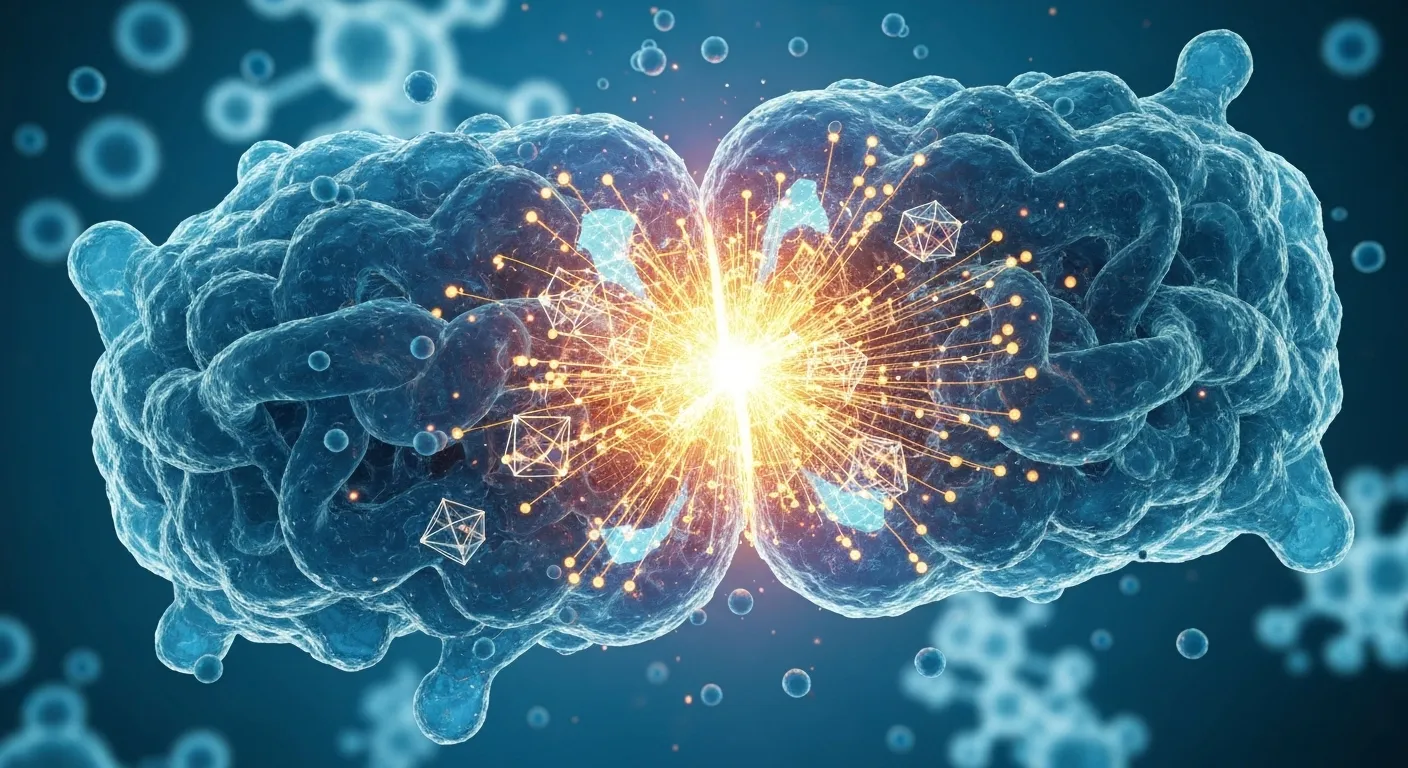
The targeting of Protein-Protein Interactions (PPIs) represents the frontier of modern computational immunology and structural biology. Unlike traditional enzymatic pockets, PPI interfaces are notoriously expansive, flat, and highly dynamic. Disrupting these networks—such as blocking the IL-17 pathway to halt syndesmophyte growth and spinal fusion in Ankylosing Spondylitis—requires more than just static docking. It demands a high-throughput, autonomous pipeline capable of continuous literature ingestion, generative structural prediction, and rigorous thermodynamic simulation.
At 33MED, we are building the foundational infrastructure for autonomous biotechnology. Our Phase 1 engine, ImmuNav, fundamentally rethinks how computational biology scales. By stripping away academic bloat—bypassing heavy Python-based orchestration frameworks and complex message brokers—we have engineered a highly performant, commercially safe ecosystem using Node.js, MongoDB, and React.
Here is an under-the-hood look at how ImmuNav identifies structural vulnerabilities in disease pathways and validates PPI disruptions at scale.
The Commercial-Safe Tool Matrix
To construct a commercial SaaS platform without falling into restrictive licensing traps (such as AlphaFold 3's non-commercial limitations), ImmuNav orchestrates a suite of fully open, commercially viable alternatives. Our backend utilizes native Node.js child_process execution to dynamically drive these engines:
| System | Application in PPI Disruption | Licensing Integration |
|---|---|---|
| Chai-1 / Boltz-1 | Multimodal prediction of complex PPI structures and potential cryptic binding pockets. | Free (Apache 2.0 / MIT). Executed via standalone pre-compiled CLI binaries using dynamically generated JSON/SMILES. |
| GROMACS | Molecular Dynamics (MD) to calculate binding thermodynamics and interface stability. | Free (GNU LGPL). Spawned via native gmx commands to monitor real-time thread progress and trajectory convergence. |
| Bioconductor | Genomic and transcriptomic mapping of cascading inflammatory pathways. | Free (Open Source). Triggered via Rscript CLI to parse patient-level RNA expression datasets. |
| Chaste | Tissue-scale simulation of cellular behavior, such as osteoblast-driven calcification. | Free (BSD License). Fired via compiled C++ binaries parsing agent-generated XML payloads. |
| OpenSim | Macroscopic validation of musculoskeletal mechanical stress post-calcification. | Free (Apache 2.0). Programmatic execution of opensim-cmd. |
The Native Node/Mongo Swarm Engine
Rather than relying on heavy message brokers like RabbitMQ or Kafka, ImmuNav leverages MongoDB as a durable, atomic task queue. This lean architecture allows our autonomous agents to continuously hypothesize, design, and queue structural physics simulations.
1. Atomic Queue Design
Our database architecture explicitly separates the agent’s global objectives from the lightweight task queue. This enables granular tracking of every thermodynamic simulation and structural prediction:
// Collections: agents (The Brains)
{
  _id: ObjectId("66654a..."),
  role: "BioinformaticsOperator",
  globalObjective: "Identify molecular targets to halt syndesmophyte growth and spine fusion.",
  humanGuidanceOverride: "Focus explicitly on small-molecule inhibitors targeting IL-17 pathways.",
  status: "active"
}

// Collections: tasks (The Muscle)
{
  _id: ObjectId("66654b..."),
  agentId: ObjectId("66654a..."),
  tool: "gromacs",
  status: "pending_review",
  payload: {
    inputFiles: ["target_complex.fasta"],
    md_params: { nsteps: 50000, dt: 0.002, integrator: "md" } // Strictly validated by Zod
  },
  humanSignOff: { isApproved: false, actionedAt: null },
  outputMetadata: { finalEnergy: null }
}
2. The Asynchronous Processing Loop
Within the ImmuNav Simulation Worker, a recursive polling loop hunts for actionable, human-approved jobs. When it finds one, it spawns native binaries directly on the host hardware, streaming standard error (stderr) logs directly into the MongoDB document for real-time observability.
async function processQueue() {
  // 1. Global Safety Check
  const globalStatus = await db.collection('settings').findOne({ key: 'swarm_status' });
  if (globalStatus?.isPaused) return setTimeout(processQueue, 5000);

  // 2. Atomic task acquisition (must be human-approved)
  const task = await db.collection('tasks').findOneAndUpdate(
    { status: 'queued', 'humanSignOff.isApproved': true },
    { $set: { status: 'processing', startedAt: new Date() } },
    { sort: { createdAt: 1 }, returnDocument: 'after' }
  );

  if (!task) return setTimeout(processQueue, 2000);

  try {
    // 3. Native physics execution
    const binaryProcess = child_process.spawn(getToolBinary(task.tool), task.payload.cliArgs);

    binaryProcess.stderr.on('data', (data) => {
      db.collection('tasks').updateOne({ _id: task._id }, { $push: { logs: data.toString() } });
    });

    binaryProcess.on('close', async (code) => {
      if (code === 0) await handleTaskSuccess(task);
      else await handleTaskFailure(task);
      processQueue();
    });
  } catch (error) {
    /* Error handling logic */
  }
}
Automated Ingestion & Target Identification
To disrupt a PPI, you must first precisely define the target landscape. ImmuNav’s Data Ingestion Agents operate entirely in the background, utilizing 100% free programmatic access to the NCBI Entrez API (PubMed) and the open arXiv API.
When raw XML text describing the latest q-bio research lands in our Node backend, it is piped directly to the Google Gemini SDK. By strictly enforcing a structured JSON output, we transform unstructured biological literature into actionable computational objectives:
const systemPrompt = `You are an expert computational immunologist. Analyze the provided scientific text.
Extract any explicit molecular targets, binding affinities, genetic expressions, or pathways related to Ankylosing Spondylitis.
Return the output strictly in the following JSON format:
{
  "targetProtein": "string",
  "associatedCytokines": ["string"],
  "observedEffect": "string",
  "confidenceScore": 0.00
}`;

const result = await geminiModel.generateContent([systemPrompt, rawPaperText]);
const structuredData = JSON.parse(result.response.text());
await db.collection('knowledge_base').insertOne(structuredData);
Absolute Executive Control: Human-In-The-Loop (HITL)
Autonomous agents designing GROMACS simulations run the risk of exhausting compute resources or chasing biologically dead-end pathways. To maintain absolute control without manually rewriting configuration files, ImmuNav features a React-based Swarm Management Dashboard.
This control center provides three critical gating mechanisms:
- The Global Interrupter: A single UI toggle updates
settings.swarm_statustoisPaused: true. The backend worker safely halts execution between jobs without corrupting active MD trajectories. - The Guidance Injector: Scientists can dynamically inject text strings into an agent's instructions (e.g., "Focus on allosteric inhibition of IL-17A/F heterodimers"). The Node backend seamlessly merges this into the LLM system prompt on the next execution cycle.
- The Mandatory Approval Gate: When the agent mathematically designs an MD run, the task rests at
pending_review. Researchers can view theZod-validated JSON parameters (likenstepsordt) in the UI, tweak them inline, and click Approve—instantly passing the task to the local hardware loop.
Safe Scaling: The Micro-Dataset Protocol
Before deploying ImmuNav against massive human spinal complexes, our engineering protocol mandates local safety loops. We stress-test the architectural piping—from Node runtime exit codes to React thermodynamic charting—using strict micro-benchmarks:
- Ingestion Sandboxing: We hardcode
&retmax=3into our Entrez queries. This ensures our regex sanitizers and Gemini pipelines process perfectly before we open the API floodgates. - Structural Sandboxing (1AKI): Rather than modeling massive interleukins during software iterations, we utilize Hen Egg White Lysozyme (PDB ID: 1AKI). A standard minimization sequence on Lysozyme takes mere minutes, providing an immediate feedback loop to verify that GROMACS commands are spawning, executing, and returning valid thermodynamic metrics to MongoDB.
By marrying bloat-free Node.js architecture with cutting-edge, commercially viable structural physics, 33MED is not just predicting protein structures. We are engineering a closed-loop platform capable of autonomously discovering, validating, and disrupting the very interactions that drive complex diseases.