---
title: "Precision at the Speed of Light"
description: "Discover how 33MED is fusing advanced surgical optics with a lean, autonomous AI swarm to revolutionize musculoskeletal modeling and robotic orthopedic surgery."
date: 2024-05-20
author: "33MED Engineering"
category: "Spine3D, Biomechanics & Surgical Robotics"
---
Precision at the Speed of Light: How Advanced Optics are Changing Orthopedic Surgery
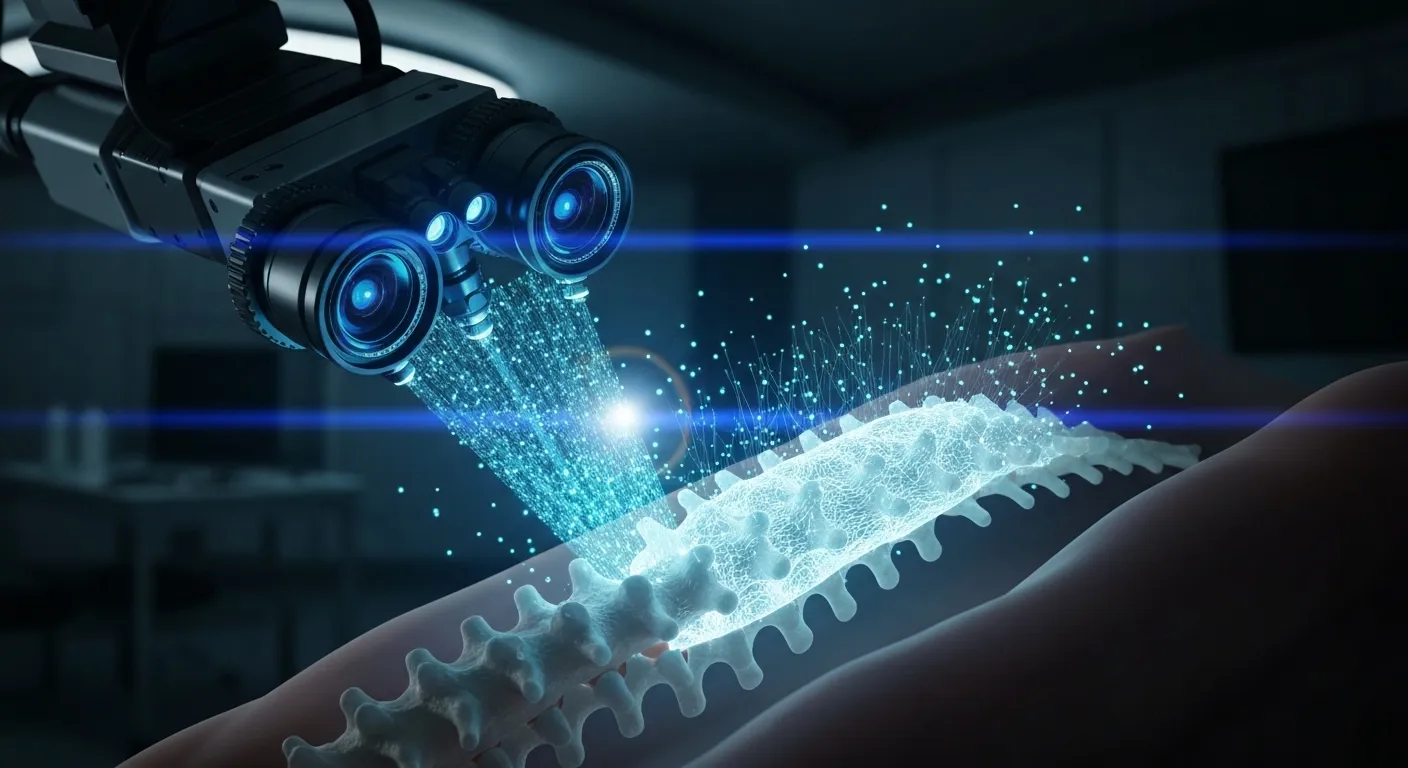
In the realm of modern orthopedic surgery, visualization is the boundary line between a successful outcome and catastrophic failure. Advanced surgical optics—from high-fidelity structured light arrays to sub-millimeter stereoscopic sensors—have effectively given surgical robotics the ability to "see" the human body in unparalleled 3D detail.
But seeing is not understanding.
Optical sensors capture millions of data points per second. Traditional surgical platforms choke on this influx, relying on bloated software architectures that introduce fatal latency between optical capture and robotic execution. At 33MED, we are pioneering the Spine3D ecosystem, bridging the gap between photonic data capture and autonomous robotic action.
To process surgical data at the speed of light, you need an engine that operates just as fast. Enter the ImmuNav Phase 1 engine: a lean, highly performant Node.js, MongoDB, and React ecosystem stripped of academic bloat, designed specifically to orchestrate advanced biomechanical and computational immunology workflows.
Here is how 33MED is leveraging this autonomous infrastructure to turn advanced optics into actionable, hyper-precise orthopedic execution.
The ImmuNav Architecture: A Native Node/Mongo Swarm Engine
Advanced surgical optics require an orchestration layer capable of translating topographical spine data into complex physics and biological simulations in real time. We bypassed the standard heavy frameworks—eliminating Python dependencies, RabbitMQ instances, and complex database abstractions—in favor of a blazing-fast, 100% commercial-safe (Apache 2.0 / MIT) micro-swarm.
Rather than relying on dedicated message brokers, ImmuNav utilizes MongoDB as a durable, atomic task queue. Our system tracks autonomous agent parameters and manages the computational pipeline across two foundational collections: agents and tasks.
// Collections: tasks (The Lightweight Queue)
{
  _id: ObjectId("66654b..."),
  agentId: ObjectId("66654a..."),
  tool: "opensim", // Or chaste, gromacs, chai1
  status: "pending_review",
  payload: {
    inputFiles: ["spine_topology_optical_scan.obj"],
    sim_params: { joint_load_threshold: 450, kinematic_smoothing: true }
  },
  humanSignOff: {
    isApproved: false,
    actionedAt: null
  },
  logs: [],
  outputMetadata: { mechanicalStressMax: 480.2 }
}
In our Simulation Worker, a lightweight, recursive polling loop queries MongoDB for actionable jobs. When optical data flags an anomaly in spinal curvature, the Node.js backend spawns native binary executions via child_process.spawn(). Real-time thread progress is monitored directly, with runtime logs piped directly into the MongoDB document.
Bridging Macro-Optics and Micro-Biology: The Core Tool Matrix
In orthopedic diseases like Ankylosing Spondylitis (AS), structural spine fusion (syndesmophyte growth) is a mechanical problem driven by a molecular trigger. Spine3D optics capture the macro-structural deformation, while ImmuNav calculates the micro-biological root cause.
Our Node.js backend orchestrates a suite of fully open, commercial-safe computational tools to build a complete picture of the patient's musculoskeletal health:
- OpenSim CLI: Programmatic execution of
opensim-cmdvalidates physical mechanical stresses on the spine based on spatial data captured by our optics. - Chaste (Cancer, Heart and Soft Tissue Environment): By firing compiled C++ binaries via an agent-generated XML payload, we map tissue-scale cellular calcification modeling, predicting how bone spurs will develop over time.
- Chai-1 / Boltz-1: Multimodal molecular structure prediction executed via pre-compiled CLI binaries to understand the underlying protein interactions driving bone disease.
- GROMACS: Native
gmxcommands monitor real-time thread progress for molecular dynamics, evaluating the thermodynamics of targeted drug interventions. - Bioconductor: Genomic and transcriptomic pathway mapping via standalone R scripts (
Rscript) to parse expression datasets.
The Data Collection Engine: Feeding the Swarm
To ensure our robotic and biomechanical models are acting on the absolute bleeding edge of computational immunology, ImmuNav features a continuous Data Ingestion Agent pipeline.
Operating seamlessly in the background, these Node.js tasks harvest raw scientific literature via the NCBI Entrez E-utilities (PubMed) and arXiv APIs. When raw XML text lands in the backend, it is routed directly to the Google Gemini SDK.
Using strict JSON structure instructions, Gemini acts as our automated immunologist, extracting molecular targets, binding affinities, and pathways related to spinal fusion diseases:
const systemPrompt = `You are an expert computational immunologist. Analyze the provided scientific text.
Extract explicit molecular targets, binding affinities, or pathways related to Ankylosing Spondylitis.
Return the output strictly in the following JSON format:
{
  targetProtein: "string",
  associatedCytokines: ["string"],
  observedEffect: "string",
  confidenceScore: 0.00
}`;
The Human-In-The-Loop (HITL) React Control Center
Automation in orthopedic surgery requires absolute executive control. Advanced optics and AI swarms are cognitive multipliers, but the surgeon and clinical engineer must remain the ultimate authority.
To achieve this without requiring manual code modifications or environment reconfigurations, we built an explicit Swarm Management Dashboard in React.
┌──────────────────────────────────────────────────────────────────────────────┐
│ IMMUNAV AUTOMATION HUB                                [ SYSTEM STATUS: RUNNING ] │
├──────────────────────────────────────────────────────────────────────────────┤
│ [ 🛑 GLOBAL SWARM PAUSE ]   [ 🔄 RESUME SYSTEM ]   [ ✍️ EDIT GLOBAL OBJECTIVE ] │
├──────────────────────────────────────────────────────────────────────────────┤
│ ACTIVE AGENTS                                                                │
│ 🤖 Agent_Ingestion_1  │ Status: [ WORKING ]  │ Task: Scraping arXiv q-bio    │
│ 🤖 Agent_Operator_3   │ Status: [ BLOCKED ]  │ Task: Awaiting Config Approval│
├──────────────────────────────────────────────────────────────────────────────┤
│ 🚨 AGENT CONFIGURATION APPROVAL GATEWAY                                      │
│ Task ID: #98322  │ Tool Target: OpenSim Musculoskeletal Dynamics              │
│ Target Interaction: L4-L5 Lumbar Load Distribution based on Optical Scan      │
│                                                                              │
│ [ View Agent-Suggested sim_params Payload ]                                  │
│  {                                                                           │
│    "kinematic_smoothing": true,                                              │
│    "joint_load_threshold": 450,                                              │
│    "mesh_resolution": "high"                                                 │
│  }                                                                           │
│                                                                              │
│  ✏️ [ Manually Edit JSON Parameters Inline ]                                  │
│  ──────────────────────────────────────────────────────────────────────────  │
│            [ ❌ REJECT CONFIGURATION ]      [ ⚠️ APPROVE & RUN JOB ]          │
└──────────────────────────────────────────────────────────────────────────────┘
- The Global Interrupter State: Toggling the Global Pause updates MongoDB instantly. Because the background worker checks this boolean before processing, the entire swarm halts safely without corrupting mid-calculation physics simulations.
- The Guidance Injector: High-level clinical pivots can be typed directly into the UI. This text is merged into the system instructions for the next LLM parameter compilation.
- The Mandatory Approval Gate: Agents generating biomechanical simulation parameters push tasks into a
pending_reviewstate. The React UI allows engineers to verify and tweakZod-validated parameters before clicking Approve, passing the execution down to local hardware loops.
Micro-Dataset Testing: Safe Iteration at Scale
Building a robotics and optical analysis platform demands rigorous local safety loops. To iterate without exhausting API quotas or crashing hardware under heavy computational physics, our engineering culture mandates strict micro-testing.
Before deploying against complex, multi-gigabyte human spinal topologies, we sandbox our architecture. Data sourcing is capped (&retmax=3), and molecular modeling scripts bypass complex human proteins in favor of standard benchmarking structures like Hen Egg White Lysozyme (PDB ID: 1AKI).
Similarly, for our mechanical modeling, we avoid loading full biomechanical skeletal rigs during initial software development. By utilizing lightweight templates—like the simple, single-joint pendulum in OpenSim or 2D cellular grids in Chaste—we verify that our React dashboards accurately render configuration panels and post-run thermodynamic charts before graduating to full 3D surgical datasets.
The Future of Spine3D
At 33MED, we believe the future of surgery isn't just about building a better camera. It is about building the biological and physical intelligence required to understand what that camera is seeing.
By combining the speed of advanced surgical optics with the lean, autonomous power of our ImmuNav Node/Mongo swarm, we are moving beyond traditional orthopedics. We are delivering precision at the speed of light.