
---
title: "Digital Twins for the Human Spine"
description: "Explore how 33MED's ImmuNav engine leverages a lean Node.js and MongoDB swarm architecture to construct patient-specific spinal digital twins for personalized surgical robotics."
date: "2024-05-24"
author: "33MED Engineering"
category: "Spine3D, Biomechanics & Surgical Robotics"
---
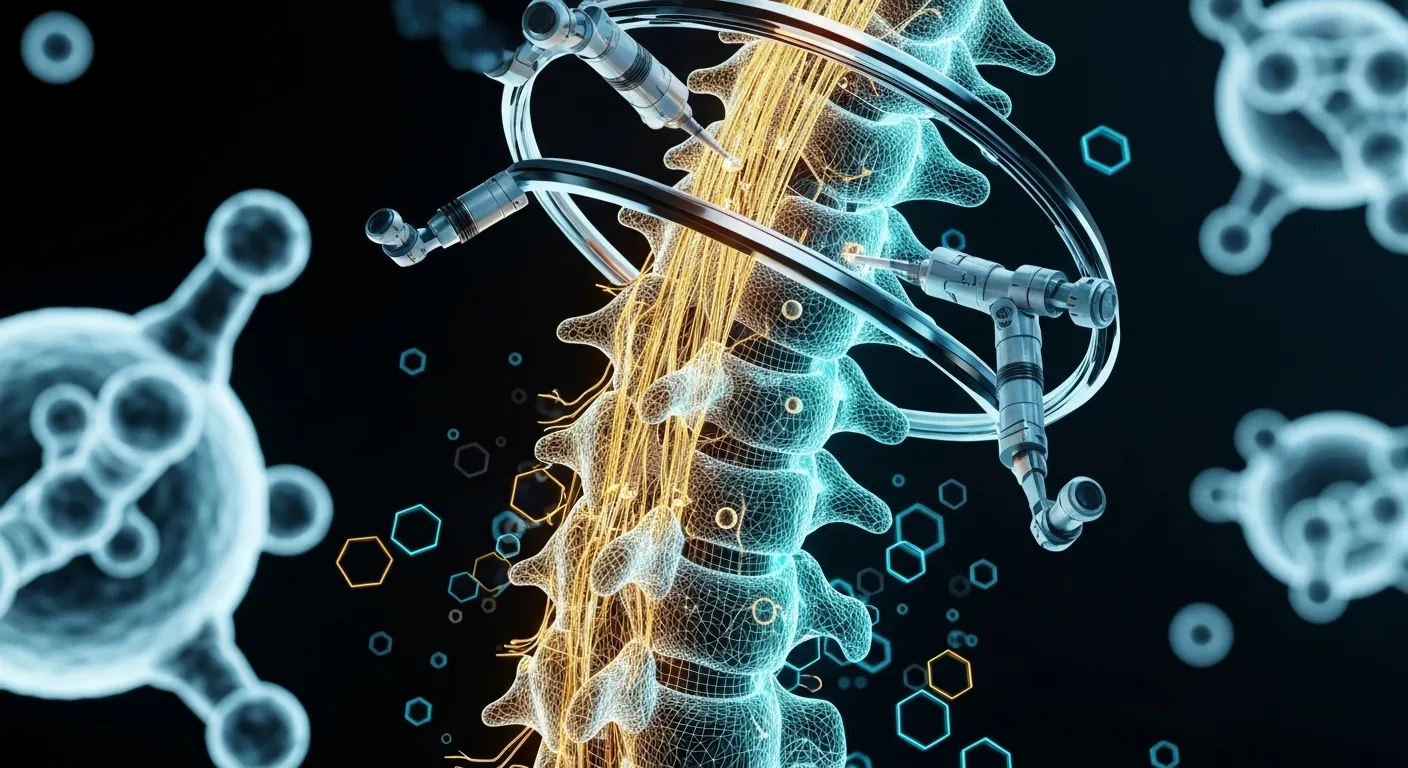
The human spine is a masterpiece of biomechanical engineering and immunological complexity. When treating degenerative pathologies, structural deformities, or autoimmune conditions like Ankylosing Spondylitis, static imaging is no longer sufficient. To pave the way for true autonomous surgical robotics and personalized intervention, surgeons require a dynamic, computational model of the patient’s anatomy—a Digital Twin.
At 33MED, we are building the foundational infrastructure to make these patient-specific digital twins a clinical reality. By evolving our ImmuNav prototype into a robust Phase 1 engine, we have engineered a high-performance, commercially viable ecosystem capable of simulating the spine across multiple scales: from molecular immunology to macroscopic biomechanical kinematics.
Here is an inside look at the technical architecture powering 33MED’s Spine3D platform.
🏗️ The Architecture: A Native Node.js & Mongo Swarm Engine
In the world of biotech infrastructure, academic bloat is the enemy of commercial execution. Heavy Python frameworks, complex message brokers like RabbitMQ, and convoluted database layers create latency and licensing headaches.
To build a commercial SaaS platform that is lean, highly performant, and 100% commercial-safe, 33MED’s architecture is rooted in a pure Node.js, MongoDB, and React ecosystem.
Rather than deploying dedicated message brokers, we utilize MongoDB as a durable, atomic task queue. Our system relies on two foundational collections to manage autonomous agents and their computational pipelines:
// Example: The Lightweight Task Queue Schema
{
  _id: ObjectId("66654b..."),
  agentId: ObjectId("66654a..."),
  tool: "gromacs", // Target execution binary
  status: "pending_review", // Enforces Human-in-the-Loop approval
  payload: {
    inputFiles: ["target_sequence.fasta"],
    md_params: { nsteps: 50000, dt: 0.002, integrator: "md" }
  },
  humanSignOff: {
    isApproved: false,
    actionedAt: null
  },
  logs: [],
  outputMetadata: { pdbId: "1AKI", finalEnergy: -420000 }
}
Running on our Simulation Worker, a recursive Node.js polling loop queries MongoDB for actionable jobs via atomic $findOneAndUpdate operations. It strictly respects global system states and mandatory human approvals before executing native binaries.
🧬 The Core Tool Matrix: 100% Commercial-Safe
A highly accurate digital twin requires multimodal simulation. To avoid the licensing pitfalls of restricted models (such as AlphaFold 3’s non-commercial wrapper), the ImmuNav engine orchestrates a matrix of fully open, commercial-safe alternatives.
These are executed directly via Node’s native child_process.spawn() and CLI execution, allowing us to pass dynamically generated payloads and monitor real-time thread progress without middle-layer friction:
- Multimodal Molecular Prediction (Chai-1 / Boltz-1): Operating under Apache 2.0 and MIT licenses, these models predict complex molecular structures. We execute them via pre-compiled CLI binaries using generated JSON/SMILES inputs.
- Molecular Dynamics (GROMACS): Leveraging this GNU LGPL tool, we monitor real-time binding thermodynamics—critical for simulating how small-molecule inhibitors interact with spinal targets.
- Pathway Mapping (Bioconductor): We parse genomic and transcriptomic RNA expression datasets by executing standalone R scripts via the
RscriptCLI. - Tissue-Scale Modeling (Chaste): To model syndesmophyte growth and cellular calcification, we fire Chaste's compiled C++ binaries, passing agent-generated XML payloads that map cellular parameters.
- Biomechanical Simulation (OpenSim CLI): To validate the physical mechanical stresses placed on the spine, we programmatically execute
opensim-cmd, mapping musculoskeletal joint and muscle loads.
📡 Autonomous Data Ingestion: The Bioinformatics Pipeline
A digital twin is only as intelligent as the data fueling it. Our Data Ingestion Agents run continuously in the background, harvesting raw literature to build a structured database of immunological targets.
Our pipeline interfaces directly with PubMed (via NCBI Entrez E-utilities, utilizing API keys for an accelerated 10 requests/second rate) and the arXiv Atom/XML feed. Once raw scientific text is ingested, it is handed off to our Gemini LLM Pipeline.
Using the @google/generative-ai SDK, we enforce strict JSON structural instructions. The LLM acts as an expert computational immunologist, extracting explicit molecular targets, cytokines, and binding affinities directly related to conditions like spinal fusion:
const systemPrompt = `You are an expert computational immunologist. Analyze the provided scientific text.
Extract any explicit molecular targets, binding affinities, genetic expressions, or pathways related to Ankylosing Spondylitis.
Return the output strictly in the following JSON format:
{
  targetProtein: "string",
  associatedCytokines: ["string"],
  observedEffect: "string",
  confidenceScore: 0.00
}`;
🎛️ Human-In-The-Loop (HITL) Executive Control
Autonomous agents require executive supervision, especially when defining parameters for surgical and pharmaceutical intervention. 33MED guarantees absolute clinical control via our React-based Swarm Management Dashboard.
This control center features three critical safety mechanisms:
- The Global Interrupter State: A single UI toggle updates the
settings.swarm_statusto{ isPaused: true }in MongoDB. The backend worker inherently checks this boolean, allowing us to safely halt the entire background swarm without breaking complex computational physics tasks mid-calculation. - The Guidance Injector: Engineers and clinicians can inject high-level directional pivots (e.g., "Focus explicitly on small-molecule inhibitors targeting IL-17 pathways"). This guidance is merged directly into the LLM's system instructions for subsequent runs.
- The Mandatory Approval Gate: When an AI agent designs a simulation run (e.g., GROMACS thermodynamic parameters), the task is flagged as
pending_review. Engineers can manually verify, tweak, and approve theZod-validated parameters in the React dashboard before the job is passed to the local hardware execution loop.
🧪 Scalable Iteration: The Micro-Dataset Protocol
To build and iterate on this colossal architecture without exhausting API quotas or crashing hardware under the weight of full musculoskeletal rigs, 33MED enforces a strict micro-testing protocol:
- API Sandboxing: We hardcode low boundaries (
&retmax=3) into our retrieval loops to validate scraping, regex sanitization, and Gemini extraction logic before opening the data floodgates. - Molecular Benchmarking: Rather than testing automated Chai-1 or GROMACS scripts on complex human spinal proteins initially, we benchmark against Hen Egg White Lysozyme (PDB ID: 1AKI). This allows us to verify that our Node runtime parses stdout strings and exit codes cleanly in under two minutes.
- Kinematic Sandboxing: Before loading 33MED's proprietary full-spine biomechanical rigs, we utilize OpenSim's simple single-joint pendulum templates. This ensures our React dashboards accurately render configuration panels and post-run thermodynamic charts.
The Future of Spine3D
By combining computational immunology with biomechanical stress mapping, 33MED’s ImmuNav engine is laying the groundwork for true patient-specific surgical robotics.
We are not just visualizing the spine; we are simulating its biology, its degradation, and its mechanical thresholds. This is the future of autonomous biotech infrastructure—and the first step toward fundamentally transforming spinal intervention.