title: "Collision Detection in Surgical Planning"
description: "How 33MED leverages native Node.js swarms, OpenSim biomechanics, and Human-in-the-Loop automation to predict and prevent mechanical failures before the first incision."
date: 2024-05-20
author: "33MED Engineering"
category: "Spine3D, Biomechanics & Surgical Robotics"
In spine surgery, a millimeter of spatial misalignment is critical, but the true root cause of post-operative mechanical failure—hardware loosening, adjacent segment disease, or cage subsidence—rarely happens on the operating table. It happens three months later under the dynamic load of human movement.
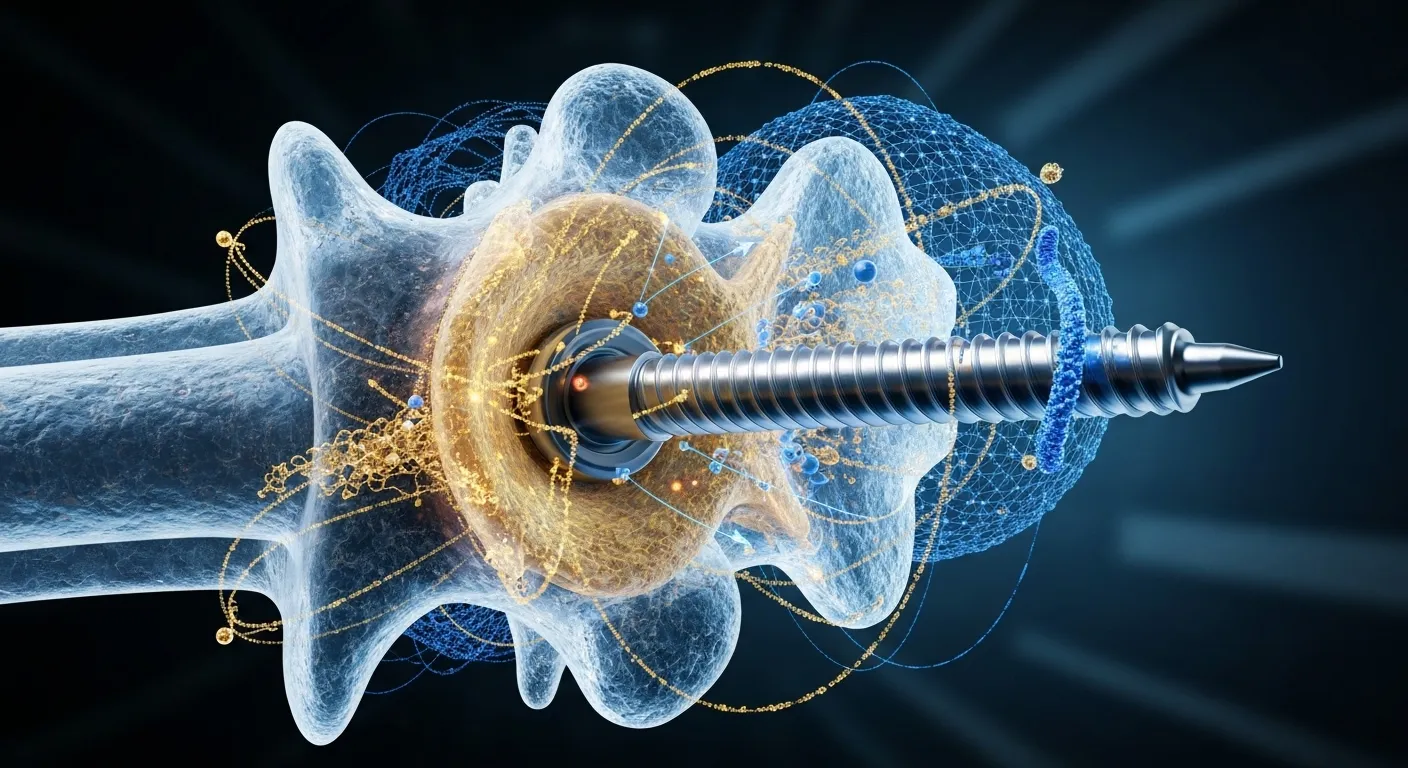
Traditional collision detection in surgical planning is purely spatial; it prevents a pedicle screw from breaching a nerve root. At 33MED, our Spine3D platform redefines collision detection as a four-dimensional, biomechanical and cellular challenge. We don't just ask if the hardware fits; we compute how the musculoskeletal system and surrounding cellular tissue will react to it over time.
To achieve this without the bloat of heavy academic frameworks, 33MED has engineered a highly performant, commercially safe Phase 1 orchestration engine. By unifying computational immunology and biomechanics via a lean Node.js, MongoDB, and React ecosystem, we simulate physiological realities before the robotic arm ever makes its first cut.
Here is an under-the-hood look at how 33MED engineers autonomous biotech infrastructure to prevent mechanical failures.
🧬 The Core Tool Matrix: 100% Free & Commercial-Safe
Predicting mechanical failure requires modeling across multiple scales: from the macro-level torque of a lumbar joint to the micro-level calcification of bone grafts. To safely build a commercial SaaS platform without restrictive licensing pitfalls, our Node.js backend bypasses academic wrappers and orchestrates fully open, native CLI alternatives using child_process execution.
| Tool | 33MED Application Area | Licensing | Orchestration Strategy |
|---|---|---|---|
| OpenSim CLI | Musculoskeletal Joint & Muscle Load Simulation | Free (Apache 2.0) | Programmatically execute opensim-cmd to validate physical mechanical stresses and implant trajectories. |
| Chaste | Tissue-Scale Cellular Calcification Modeling | Free (BSD License) | Fire compiled C++ binaries with XML payloads to model bone fusion (e.g., syndesmophyte growth). |
| GROMACS | Molecular Dynamics (Hardware/Tissue Interface) | Free (GNU LGPL) | Spawn native gmx commands via Node child_process.spawn() to monitor real-time thread progress. |
| Chai-1 / Boltz-1 | Multimodal Molecular Structure Prediction | Free (Apache 2.0 / MIT) | Execute via standalone binaries for biochemical interaction mapping around the implant site. |
| Bioconductor | Genomic / Transcriptomic Pathway Mapping | Free (Open Source) | Execute standalone R scripts via Rscript CLI to parse patient expression data. |
By keeping execution at the native CLI level, our architecture remains incredibly fast, durable, and highly scalable.
🏗️ Architecting the Native Node/Mongo Swarm Engine
Complex surgical simulations require bulletproof task queuing. Rather than introducing the overhead of dedicated message brokers like RabbitMQ or Kafka, Spine3D utilizes MongoDB as a durable, atomic task queue.
MongoDB Schema Design
Our database architecture tracks autonomous agent parameters and pipeline tasks in real-time. This ensures every biomechanical simulation is structurally validated before hitting the hardware.
// Collections: agents
{
  _id: ObjectId("66654a..."),
  role: "BiomechanicsOperator",
  status: "active",
  globalObjective: "Simulate L4-L5 load distribution post-cage insertion to predict adjacent segment disease.",
  humanGuidanceOverride: "Focus explicitly on shear forces during 30-degree flexion.",
  lastPulse: ISODate("2024-05-20T22:00:00Z")
}

// Collections: tasks (The Lightweight Queue)
{
  _id: ObjectId("66654b..."),
  agentId: ObjectId("66654a..."),
  tool: "opensim_cmd",
  status: "pending_review",
  payload: {
    inputFiles: ["patient_L4_L5_kinematics.osim"],
    sim_params: { nsteps: 50000, dt: 0.002, integrator: "rk4" } // Validated by Zod
  },
  humanSignOff: {
    isApproved: false,
    actionedAt: null
  },
  logs: [],
  outputMetadata: { maxStressMPa: 45.2, failureRisk: "low" }
}
The Node.js Background Processing Loop
In our Simulation Worker, a lightweight, recursive polling loop queries MongoDB for actionable jobs. It strictly respects global system states and checks for mandatory human approvals—meaning an unverified surgical simulation is never passed to the robotic execution layer.
async function processQueue() {
  // 1. Structural Check: Ensure the entire swarm isn't globally paused
  const globalStatus = await db.collection('settings').findOne({ key: 'swarm_status' });
  if (globalStatus?.isPaused) {
    setTimeout(processQueue, 5000);
    return;
  }

  // 2. Fetch the next executable task (Must be approved and queued)
  const task = await db.collection('tasks').findOneAndUpdate(
    { status: 'queued', 'humanSignOff.isApproved': true },
    { $set: { status: 'processing', startedAt: new Date() } },
    { sort: { createdAt: 1 }, returnDocument: 'after' }
  );

  if (!task) {
    setTimeout(processQueue, 2000); // Back off if queue is empty
    return;
  }

  try {
    // 3. Native binary execution via Node Child Processes
    const binaryProcess = child_process.spawn(getToolBinary(task.tool), task.payload.cliArgs);

    binaryProcess.stderr.on('data', (data) => {
      // Append runtime logs directly to the MongoDB task document
      db.collection('tasks').updateOne({ _id: task._id }, { $push: { logs: data.toString() } });
    });

    binaryProcess.on('close', async (code) => {
      if (code === 0) {
        await handleTaskSuccess(task);
      } else {
        await db.collection('tasks').updateOne({ _id: task._id }, { $set: { status: 'failed' } });
      }
      processQueue(); // Instantly jump to the next job
    });

  } catch (error) {
    await db.collection('tasks').updateOne({ _id: task._id }, { $set: { status: 'failed', error: error.message } });
    processQueue();
  }
}
📡 The Data Ingestion Pipeline: Connecting Literature to Patient Physics
Collision detection isn't just about the patient's immediate anatomy; it is informed by thousands of historical surgical outcomes. Our automated background agents continuously harvest raw biomechanical data and literature.
- PubMed (NCBI E-utilities): Accessed via a free API key at 10 requests/second, our Node backend utilizes
axiosto target specific keyword pairs (e.g.,Ankylosing Spondylitis AND syndesmophyte AND pedicle screw failure). - arXiv Sourcing: Querying the native Atom/XML feeds for the latest pre-prints in computational biology and musculoskeletal modeling.
Once XML text lands in the Node backend, it is passed to the Google Gemini SDK with strict system prompts. Gemini extracts structured data (e.g., binding affinities, bone density degradation rates, mechanical thresholds) and returns a validated JSON payload directly into our knowledge base. This ensures our OpenSim and Chaste simulations are driven by the absolute latest clinical parameters.
🎛️ Human-In-The-Loop (HITL) React Control Center
Absolute safety in surgical robotics requires executive human oversight. We guarantee control over our AI agents via our React Frontend Control Center, without ever requiring engineers or surgeons to modify underlying code.
┌──────────────────────────────────────────────────────────────────────────────┐
│ SPINE3D AUTOMATION HUB                                [ SYSTEM STATUS: RUNNING ] │
├──────────────────────────────────────────────────────────────────────────────┤
│ [ 🛑 GLOBAL SWARM PAUSE ]   [ 🔄 RESUME SYSTEM ]   [ ✍️ EDIT GLOBAL OBJECTIVE ] │
├──────────────────────────────────────────────────────────────────────────────┤
│ ACTIVE AGENTS                                                                │
│ 🤖 Agent_Ingestion_1  │ Status: [ WORKING ]  │ Task: Scraping arXiv q-bio    │
│ 🤖 Agent_Operator_3   │ Status: [ BLOCKED ]  │ Task: Awaiting Config Approval│
├──────────────────────────────────────────────────────────────────────────────┤
│ 🚨 AGENT CONFIGURATION APPROVAL GATEWAY                                      │
│ Task ID: #98322  │ Tool Target: OpenSim Biomechanical Simulation              │
│ Target Interaction: L4-L5 Cage Load Distribution during 30° Flexion           │
│                                                                              │
│ [ View Agent-Suggested sim_params Payload ]                                  │
│  {                                                                           │
│    "integrator": "rk4",                                                      │
│    "nsteps": 50000,                                                          │
│    "dt": 0.002                                                               │
│  }                                                                           │
│                                                                              │
│  ✏️ [ Manually Edit JSON Parameters Inline ]                                  │
│  ──────────────────────────────────────────────────────────────────────────  │
│            [ ❌ REJECT CONFIGURATION ]      [ ⚠️ APPROVE & RUN JOB ]          │
└──────────────────────────────────────────────────────────────────────────────┘
- The Global Interrupter: Toggling "Global Pause" updates MongoDB
settings.swarm_status. The background Node worker detects this boolean and halts without breaking running calculations. - The Guidance Injector: Surgeons can inject clinical notes ("Account for high osteopenia risk"). The string appends to the database, instantly redirecting the agent's parameter generation for the next simulation phase.
- The Approval Gate: Every dynamic simulation generated by the AI is flagged
pending_review. Only when a human clicks Approve does the state shift toqueued, seamlessly passing the rigorous,Zod-validated parameters down to local hardware for execution.
🧪 Micro-Dataset Testing: The 33MED Safety Loop
Running multi-scale biological physics is computationally intensive. To iterate rapidly on our surgical planning algorithms without melting local hardware or hitting API limits, 33MED enforces a strict micro-testing protocol:
- Data Sandboxing: We hardcode boundaries during pipeline development (e.g.,
&retmax=3on PubMed queries) to ensure parsing logic and Gemini extraction operate flawlessly on small batches before ingesting thousands of records. - Molecular Baselines: We benchmark our biochemical orchestration using small standard structures like Hen Egg White Lysozyme (PDB ID: 1AKI). A full GROMACS energy minimization on 1AKI runs in under two minutes, providing instant validation that our Node runtimes are parsing
stdoutand exit codes properly. - Mechanical Baselines: Rather than rendering full skeletal rigs in development, we load simple single-joint pendulum templates directly from the open-source OpenSim repositories. This allows our frontend engineers to rapidly verify that parameter tweaks in the React dashboard accurately trigger the correct physics rendering engines locally.
The Future of the Incision
By marrying lean Node.js architecture with powerhouse open-source physics engines, 33MED is moving surgical planning beyond static 3D models. We are building an autonomous infrastructure that anticipates the biochemical and biomechanical future of the patient.
Collision detection is no longer just about avoiding nerves today—it's about engineering hardware and biology to act in perfect unison for decades to come.